
By Mindit Consulting | Background Screening and Workforce Risk

There’s a question that tends to come up at the worst possible moment.
Your compliance team gets a notification: an external audit is scheduled in 30 days. Contracts get pulled. Processes get documented. Financial records are stacked in folders. And then, somewhere in the middle of that scramble, someone asks: “When did we last verify our existing employees?”
For most organisations, the honest answer is: at onboarding. Which, depending on the employee, could mean a year ago. Or three. Or five.
That’s the audit readiness gap. And it’s far more common than anyone likes to admit.
What auditors are actually looking for
It doesn’t matter whether it’s an ISO certification review, a client contractual audit, or a regulatory inspection from a financial authority. The workforce-related questions tend to be the same.
1. Current legal and criminal status
Are any current employees involved in active court proceedings, criminal investigations, or have recent convictions? This question is especially pointed for roles with financial access, data handling, or direct client responsibility. An onboarding check from two years ago tells you nothing about what happened last month.
2. Sanctions and watchlist exposure
Global sanctions databases are updated continuously, sometimes weekly. An employee who was clean at the time of hiring can appear on a watchlist years later. In banking, fintech, energy, and other regulated sectors, auditors are checking this. If you’re not, that gap will show.
3. Conflicts of interest
This one is trickier because conflicts rarely exist at the point of hire. They develop over time. A procurement manager who was completely clean when they joined may have quietly built a shareholding in a supplier. A finance lead may have taken a consultancy arrangement with a competitor. These relationships are almost impossible to detect without a structured, periodic review process.
4. Reputational exposure
Negative media coverage, public controversies, or conduct that creates legal exposure for the organisation. Again, this isn’t something that shows up in an onboarding check. It’s something that can emerge months or years into an employment relationship.
5. Documentation and consent trail
Auditors don’t just want to know that checks were done. They want to know when, which checks, and whether proper consent was obtained. A single background report from three years ago isn’t a compliance posture. It’s a historical footnote.
The real problem with onboarding checks
The standard pre-employment background check is designed for one specific moment: the hiring decision. It answers the question, “Is this person suitable to join our organisation right now?” And it does that job well.
But here’s the thing. Organisations don’t stay static, and neither do people.
Someone who joined with a clean record might face serious financial difficulties two years later. A manager who was conflict-free at hire may have developed business interests that create a genuine problem today. None of that is captured in a document that was signed off at onboarding.
The uncomfortable truth is this: if your most recent employee verification is more than 12 months old, you can’t honestly claim to know the current risk profile of your workforce. And neither can an auditor trying to assess your compliance posture.
What “audit-ready” actually means for HR compliance teams
Being audit-ready on workforce integrity isn’t about having spotless records. It’s about being able to answer these questions with confidence, at any time, without a month of frantic preparation:
- Do we know the current legal status of employees in sensitive roles?
- Are any staff names flagged on sanctions or watchlists updated in the last 90 days?
- Do we have documented, consent-based verification records that are less than 12 months old?
- Can we demonstrate a systematic, repeatable process for monitoring workforce integrity?
- Is there a clear audit trail showing when checks were performed, what they covered, and who authorised them?
If even one of those answers is “no” or “I’m not sure,” you have a finding waiting to happen. And findings that stem from process gaps are often the most expensive to remediate, because they point to systemic issues rather than isolated incidents.
The industries where this is no longer optional
Continuous workforce screening is relevant across sectors, but the regulatory pressure and contractual expectation is highest in a handful of specific areas.
Banking and Financial Services
Regulatory frameworks like DORA and MiFID II are increasingly requiring organisations to demonstrate ongoing due diligence on their staff. For roles with access to client funds or sensitive data, periodic re-verification is becoming a compliance baseline rather than a best practice. The question isn’t whether regulators will eventually ask about this. It’s when.
BPO and Shared Service Centres
Client contracts in this sector increasingly include audit rights and indemnity clauses that place direct liability on the service provider for employee conduct. A single undisclosed issue with a staff member can trigger a contract termination clause. Continuous screening protects both sides of that relationship.
IT and Software Development
With remote work now standard and developers regularly accessing sensitive client systems, the risk profile of technical staff extends well beyond their CV. Sanctions exposure, legal status, and even conduct on professional networks are all relevant. This is an area where organisations consistently underestimate their exposure.
Energy and Industrial
Regulatory inspections in critical infrastructure are tightening. Demonstrating that workforce verification is ongoing — not a one-time event — is an increasingly explicit expectation, particularly for roles with access to regulated systems or sensitive operational data.
Healthcare and Pharmaceutical
Patient safety obligations and data protection regulations create direct legal liability tied to employee conduct. In many jurisdictions, continuous verification isn’t just recommended. It’s a regulatory requirement.
How Employee Continuous Screening works in practice
Mindit Consulting’s Employee Continuous Screening service is built for organisations that want a current, verifiable, and auditable workforce compliance posture, without turning it into a major operational project.
The process is straightforward:
- Define scope and frequency. Choose the employee population (all staff, or specific role categories) and the review cycle: quarterly, biannual, or annual.
- Collect consent. Employees are informed and provide documented consent, in full compliance with GDPR and applicable data protection rules. No check runs without that consent on file.
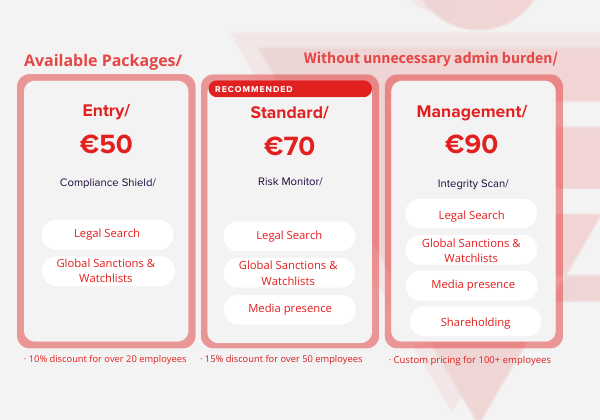
- Run verification through official sources. Checks are conducted through official legal databases, global sanctions and watchlist databases, media monitoring, and (for management-level roles) shareholding and conflict of interest registries.
- Receive secure reports. Individual results are compiled and delivered securely to HR or compliance teams, typically within 3 to 5 business days.
- Retain audit documentation. Each cycle generates a documented record: who was checked, when, what was covered, and what consent was obtained. That documentation is exactly what auditors want to see.
Three packages, designed around different risk profiles:
Starting with a pilot
One of the most common objections to rolling out continuous screening is the perceived complexity of applying it across an entire workforce. That concern is understandable. But it’s also largely unfounded.
Our recommendation is always to start with a pilot group: typically 10 to 30 employees in the highest-risk roles (finance, senior management, data access). Run one cycle. Review the output. Assess whether the findings justify broader rollout.
Most organisations that go through a pilot discover two things: the process is significantly simpler than they expected, and the output is more revealing than they anticipated. That combination tends to drive fast expansion to the broader workforce.
There’s no long-term commitment required to start.
The posture shift worth making
The organisations best prepared for audits aren’t the ones that scramble when the notification arrives. They’re the ones that have built continuous compliance into their operational rhythm, so that when an auditor asks “when did you last verify your employees?”, the answer isn’t “at onboarding.”
It’s “last quarter. Here’s the documentation.”
Ready to close the audit readiness gap?
If you’re an HR Manager, People Operations lead, or compliance professional looking to strengthen your workforce integrity posture, we’d be glad to walk you through how Employee Continuous Screening could work for your organisation.
Contact us: operations@mindit.ro
Mindit Consulting provides background screening and workforce risk services to organisations across Romania and Europe. All screening services are conducted with employee consent and in full compliance with GDPR.